Journal · Working collection
Public domain art for RPG zines.
29 old prints sorted by how they photocopy.
This is a working set of public domain art for RPG zines: twenty-nine prints of dungeons, skeletons, demons and beasts made between 1493 and 1904, grouped by how they behave on a photocopier or a risograph. Every image is CC0 or public domain, and each one downloads at full resolution from its Arkivism page with a credit line attached.
29 works from 5 collections. Open an image for a closer look and its credit line.
A zine usually prints one ink or one toner on cheap paper, so every picture ends up as pure black on white. Old prints are already lines of ink on paper, which is why so many indie games use them. The subject is the easy part. The technique decides whether the picture survives. A woodcut, an engraving and an etching break down in different ways when they are reduced and copied, so the set is grouped by technique, with a size to aim for in each group.
Before any of these goes to print: download the full-resolution file, convert it to greyscale, move the levels until the paper turns white and the lines stay black, crop to the printed border, and print one test at the final size. The captions flag the prints that need extra care.
Woodcuts and relief prints: safe at any size
A woodcut is a relief print. The cutter carves away everything that should print white and inks the ridges left standing, the same way type is inked, which is why early printers could set woodcuts beside text on one press. A line has to be thick enough to survive the knife, so it is thick enough to survive a copier. These eleven can go small: a column, a quarter page, a margin.
 Look closer ↗
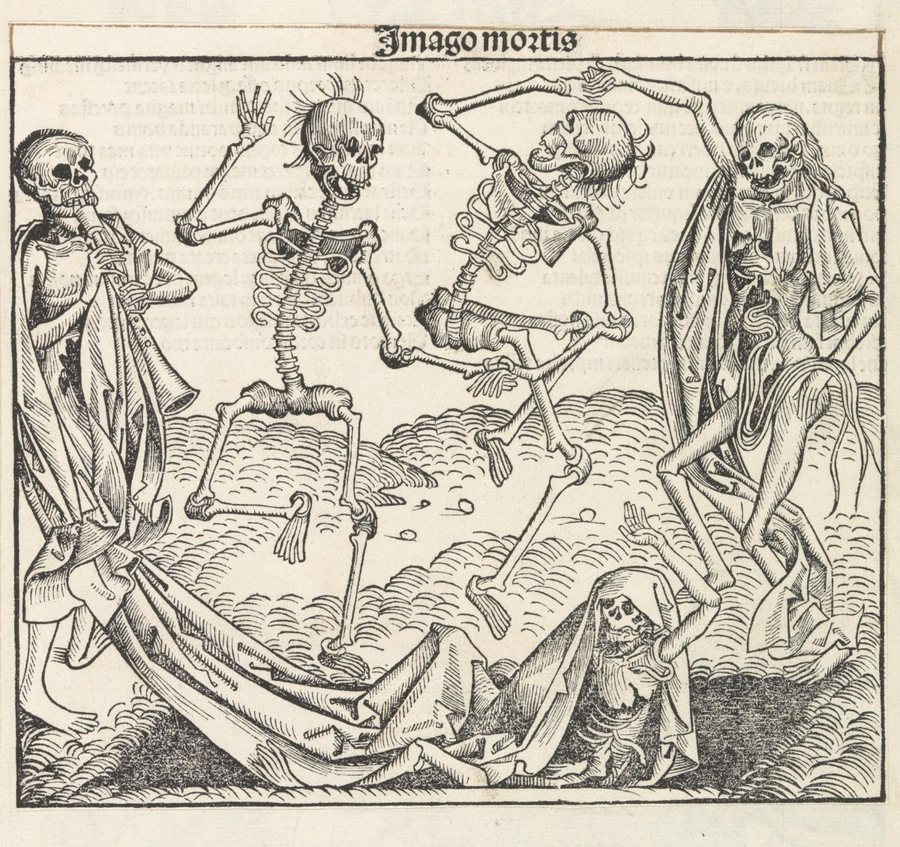
Four skeletons dance on a bare hill while one plays a pipe and a fifth climbs out of a grave under its shroud. The page comes from the Nuremberg Chronicle, printed by Anton Koberger with woodcuts from Michael Wolgemut's workshop. Each rib is a single black stroke, so the figures stay legible at postcard size. Text from the back of the leaf shows through the paper; raise the levels until it drops out. Rijksmuseum, public domain.
Dansende skeletten. 1493. Rijksmuseum, Amsterdam. Public domain. Via Arkivism: https://arkivism.com/work/rijks-RP-P-2016-49-96-2
 Look closer ↗
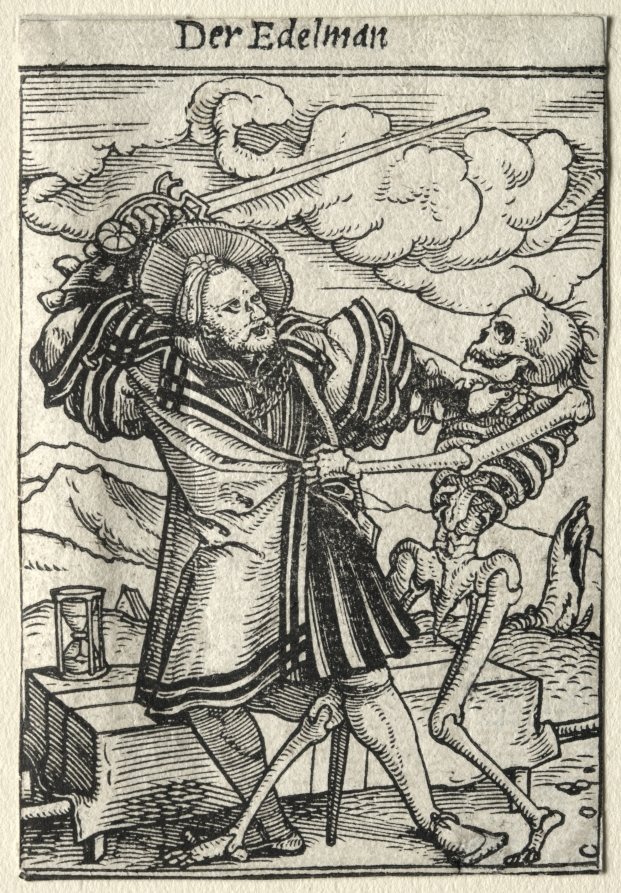
The Cleveland sheet measures 6.8 by 4.6 cm, smaller than a playing card. The nobleman swings his sword over his head while Death hauls on his coat, and an hourglass stands on the stone chest behind them. Holbein designed the series and Hans Lützelburger cut the blocks; it appeared as a book in 1538. Made this small on purpose, it takes a column width without losing a line. Cleveland Museum of Art, CC0.
Dance of Death: The Nobleman, c. 1526. Hans Holbein the Younger (German, active England and Switzerland, 1497/98–1543). Woodcut; sheet: 6.8 x 4.6 cm (2 11/16 x 1 13/16 in.). The Cleveland Museum of Art, Dudley P. Allen Fund, 1929.152. Via Arkivism: https://arkivism.com/work/cma-110587
 Look closer ↗
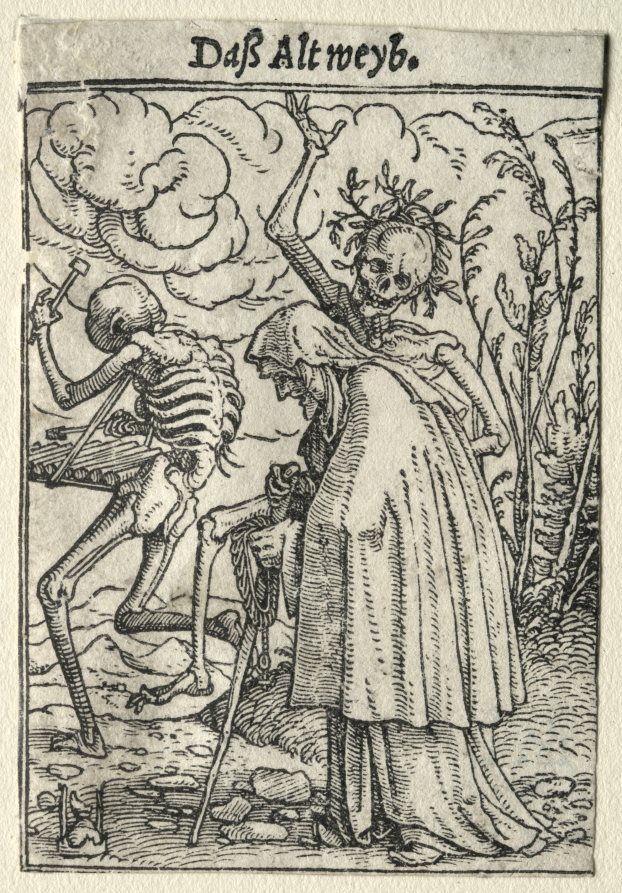
Two skeletons lead a stooped old woman who grips a stick and a rosary. One skeleton wears a wreath of leaves on its skull; the other strikes a stringed instrument slung at its hip. The German title "Daß Altweyb" is set in type above the block. A clean header for a death table or a graveyard encounter. Cleveland Museum of Art, CC0.
Dance of Death: The Old Woman, c. 1526. Hans Holbein the Younger (German, active England and Switzerland, 1497/98–1543). Woodcut. The Cleveland Museum of Art, Gift of The Print Club of Cleveland, 1929.160. Via Arkivism: https://arkivism.com/work/cma-110596
 Look closer ↗
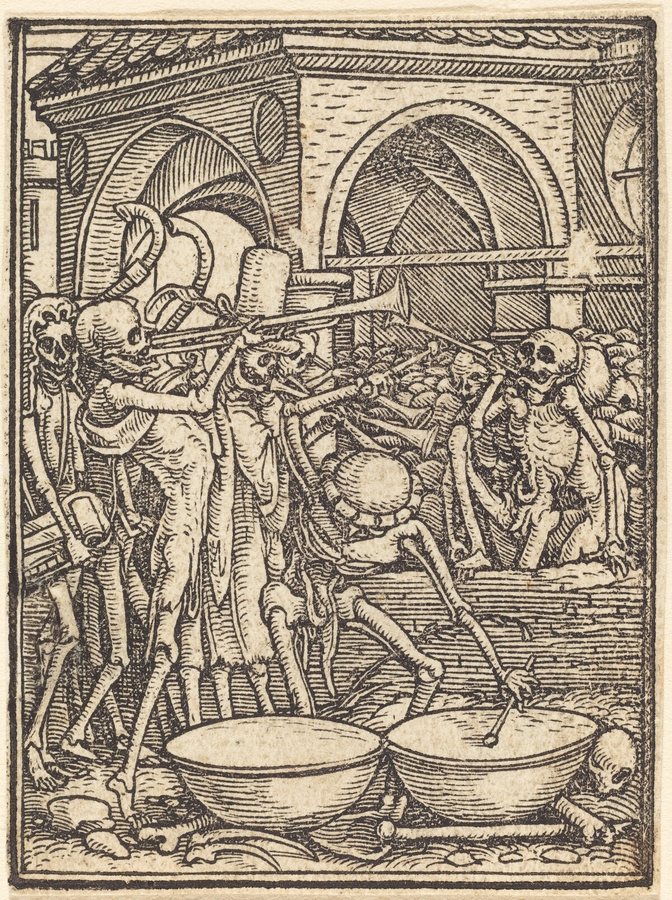
A band of skeletons blows trumpets and pounds a pair of kettledrums in front of an arcade piled with skulls and bones. The shading in the arches is parallel lines rather than crosshatching, so it stays grey instead of clogging to black when copied. Use it for an ossuary room or a crypt gate. National Gallery of Art, CC0.
Skeletons Making Music. c. 1526. Hans Lützelburger after Hans Holbein the Younger. National Gallery of Art, Rosenwald Collection. CC0. Via Arkivism: https://arkivism.com/work/nga-7769
 Look closer ↗
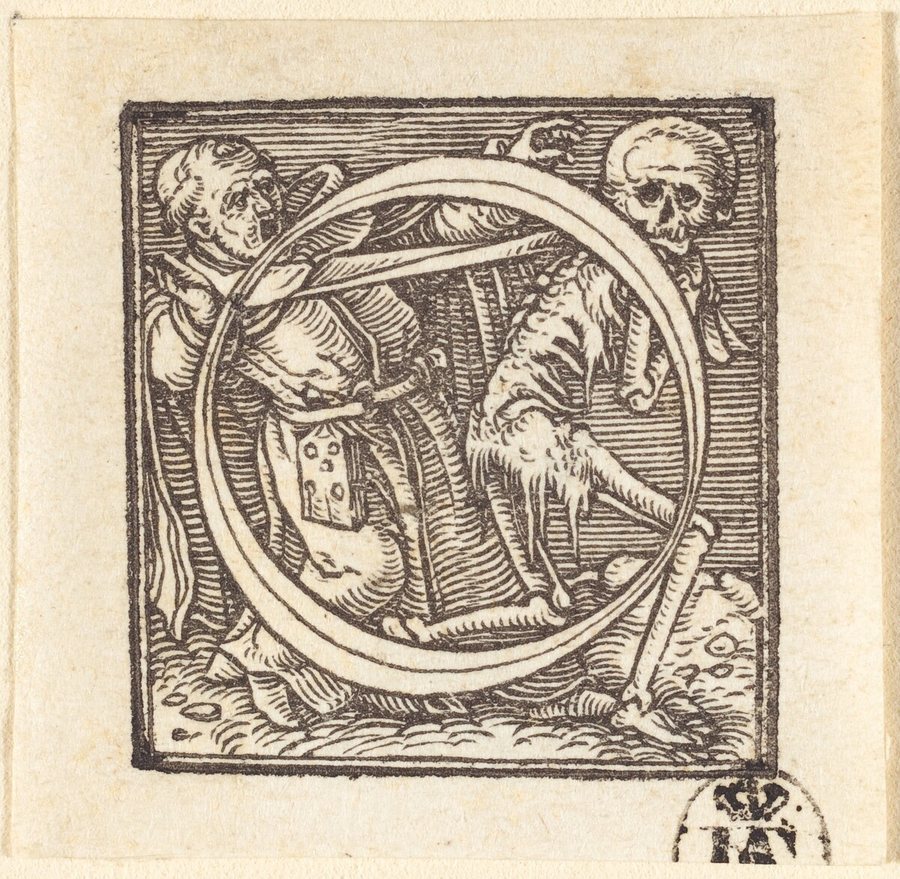
A drop cap from the same team: Death drags a terrified man through the ring of a letter O, on a ground of ruled horizontal lines. A square initial block was made to sit beside text, so this one opens a room description in a zine column. The collector's stamp at lower right sits outside the black border; crop to the border. National Gallery of Art, CC0.
Letter O. c. 1523. Hans Lützelburger after Hans Holbein the Younger. National Gallery of Art, Rosenwald Collection. CC0. Via Arkivism: https://arkivism.com/work/nga-11939
 Look closer ↗
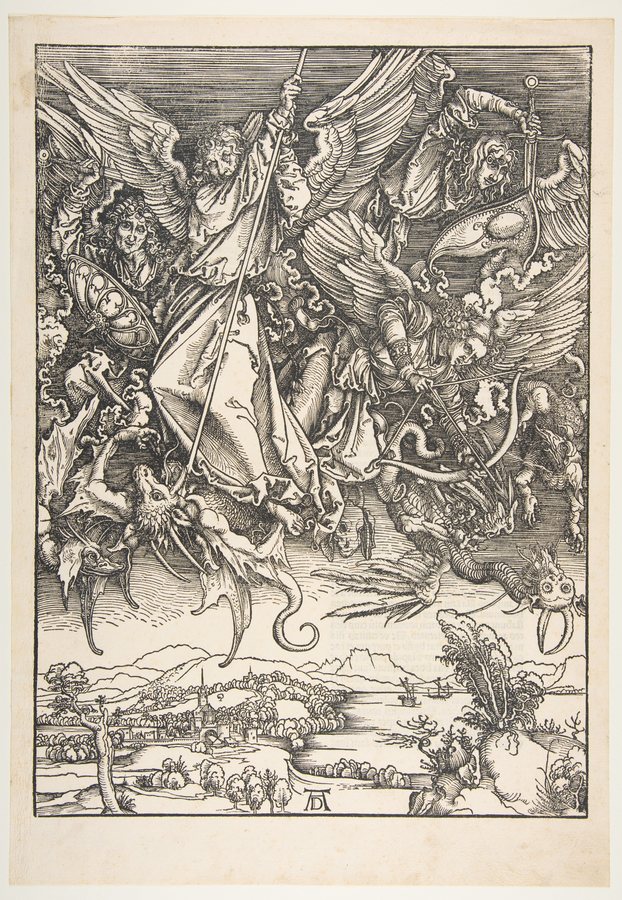
Michael drives a lance into a dragon while three angels fight with sword, bow and shield, and horned, clawed shapes fill the sky above a quiet lake town. It is one of the fifteen woodcuts of Dürer's Apocalypse, first published in 1498. The image is 39.2 by 28.3 cm, so it holds as a full-page plate or a cover, and the empty horizon gives you room for a title. Metropolitan Museum of Art, CC0.
Saint Michael Fighting the Dragon, from "The Apocalypse". 1511. Albrecht Dürer. The Metropolitan Museum of Art, The George Khuner Collection, Gift of Mrs. George Khuner, 1975. CC0. Via Arkivism: https://arkivism.com/work/met-368339
 Look closer ↗
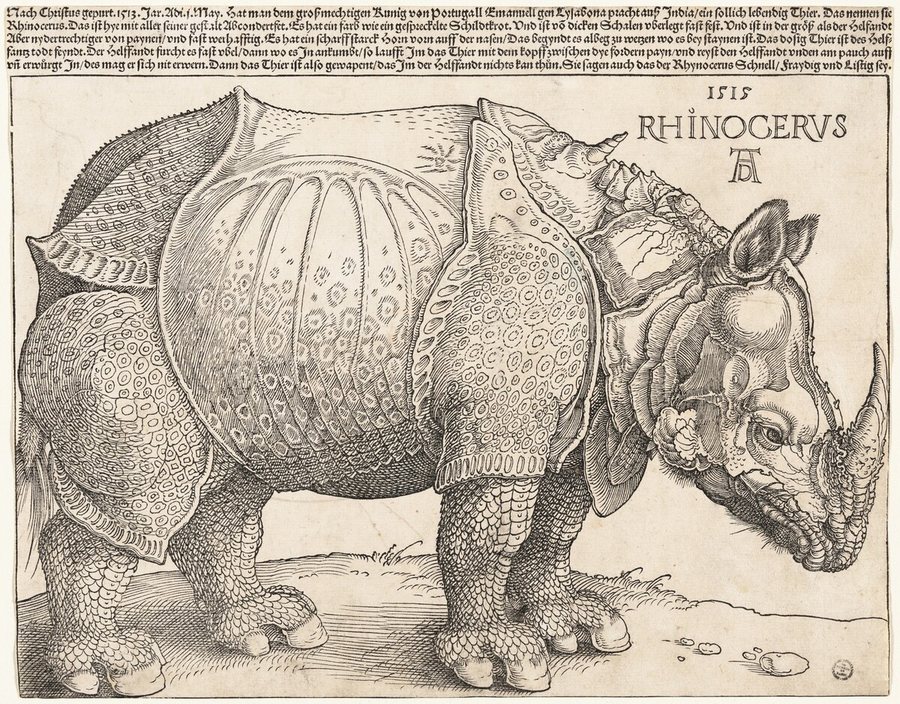
Dürer never saw this animal. He worked from a written description and a sketch of an Indian rhinoceros that reached Lisbon in 1515, and gave it plate armour, scaled legs and a small extra horn on its shoulder. That makes it more useful to a bestiary than an accurate drawing: it already reads as a monster. The German text above explains the beast; crop it off or keep it as found lore. National Gallery of Art, CC0.
The Rhinoceros. 1515. Albrecht Dürer. National Gallery of Art, Rosenwald Collection. CC0. Via Arkivism: https://arkivism.com/work/nga-47903
 Look closer ↗
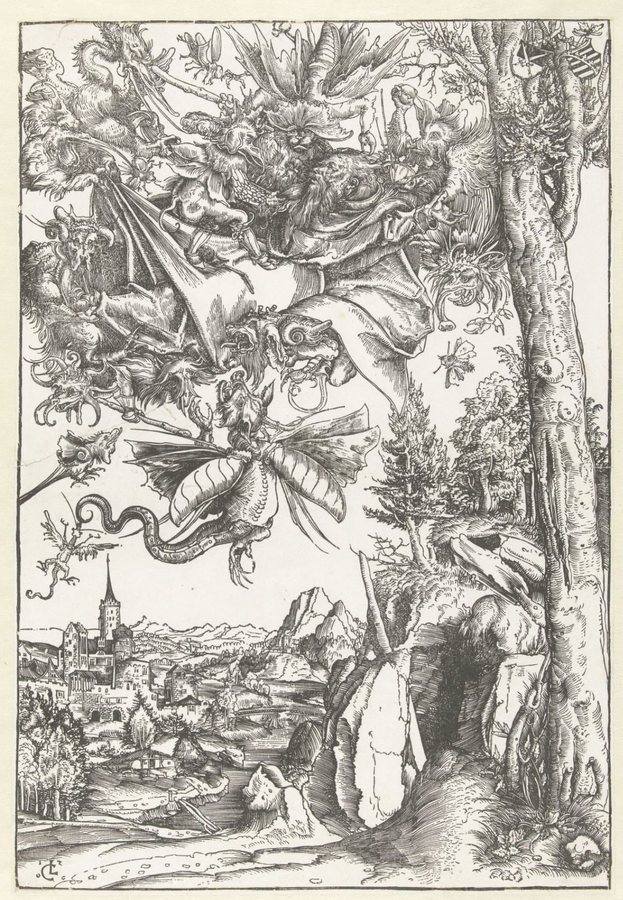
Demons built from parts of fish, bird, bat and boar carry Anthony into the air. Below them lie his cave, a town on a river and, in the tree, the arms of Saxony. The top half is a full swarm of monsters and the bottom half is an overland travel scene, so one scan gives two illustrations. Rijksmuseum, public domain.
Verzoeking van Antonius met aanval door demonen. 1506. Lucas Cranach (I). Rijksmuseum, Amsterdam. Public domain. Via Arkivism: https://arkivism.com/work/rijks-RP-P-OB-4471
 Look closer ↗
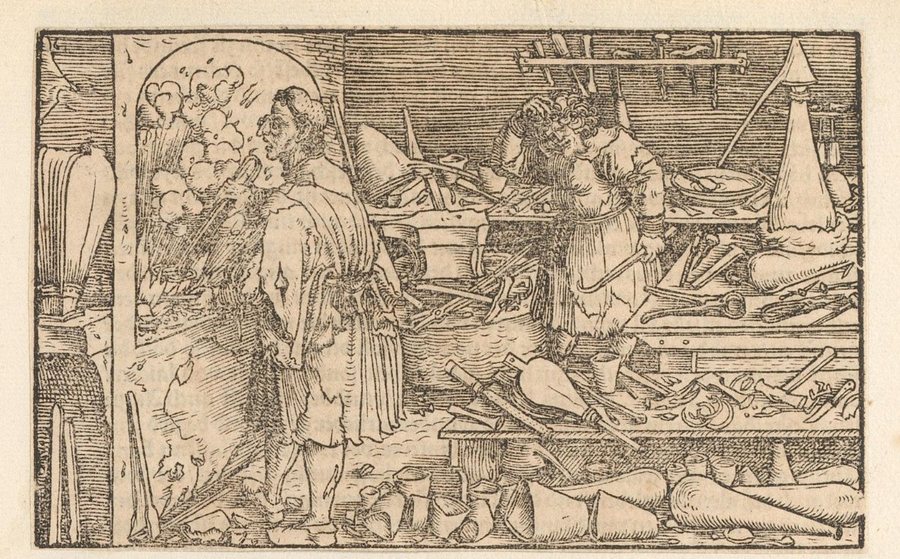
A man in a torn robe stands by a smoking furnace while another tears at his hair at a bench heaped with broken flasks and tools, a pair of bellows hanging on the wall. The cutting is rough and the line weight uneven, which suits a wizard's ruined laboratory better than a tidy engraving would. A quarter-page spot. Rijksmuseum, public domain.
Twee alchemisten in hun werkplaats. 1514 - 1532. anonymous. Rijksmuseum, Amsterdam. Public domain. Via Arkivism: https://arkivism.com/work/rijks-RP-P-2018-3210-15-1
 Look closer ↗
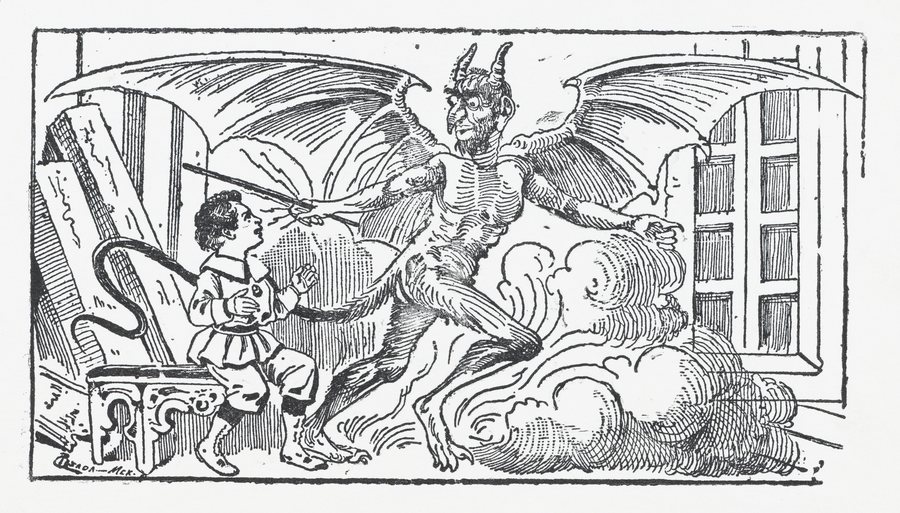
A horned, bat-winged demon arrives through a window on a cloud of smoke and reaches toward a boy on a bench. Posada made it as a zincograph, a relief print from a zinc plate, to illustrate a popular story; this is a later impression. He spent his career on cheap illustrated broadsides, which is the zine's own ancestry. The image is 8.7 by 16.2 cm, so it prints at the size it was made. Metropolitan Museum of Art, CC0.
A young boy cowering from a demon, illustration from 'El cuento Nniño de los dulces'. ca. 1880–1910 (a later impression). José Guadalupe Posada. The Metropolitan Museum of Art, Gift of Roberto Berdecio, 1960. CC0. Via Arkivism: https://arkivism.com/work/met-735920
 Look closer ↗
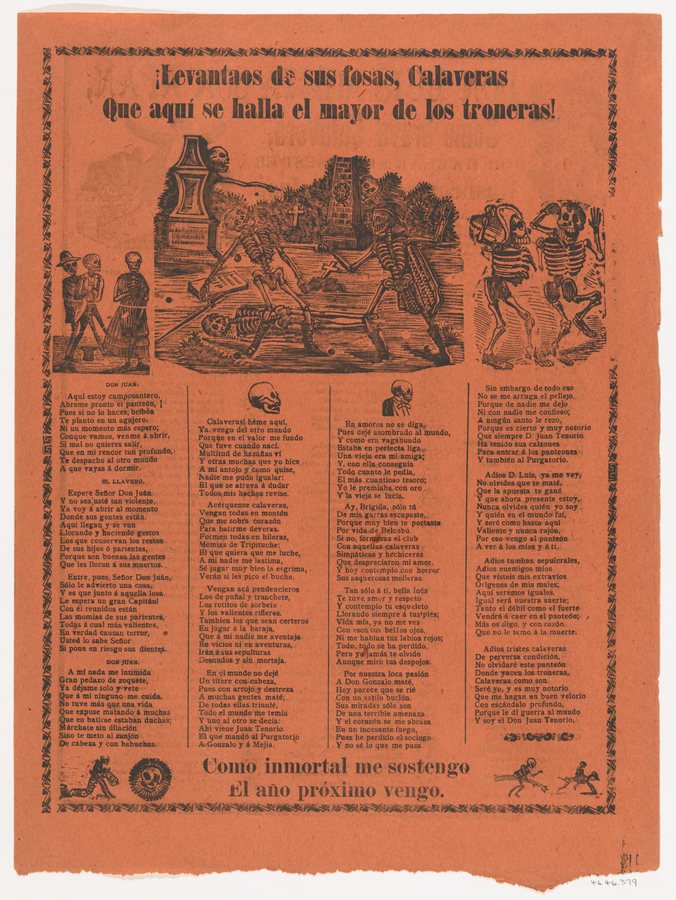
Skeletons duel with swords among tombstones under the headline "¡Levantaos de sus fosas, Calaveras!" (rise from your graves, skulls), above four columns of verse. The picture is a type-metal engraving printed with the letterpress text on orange paper. It is a one-page dungeon layout already solved: headline, picture, columns. Convert to greyscale and lift the orange to white before copying. Metropolitan Museum of Art, CC0.
Broadsheet relating to skeletons rising from their graves, two skeletons duelling with swords. 1904. José Guadalupe Posada. The Metropolitan Museum of Art, The Elisha Whittelsey Collection, The Elisha Whittelsey Fund, 1946. CC0. Via Arkivism: https://arkivism.com/work/met-717520
Engravings: give them half a page
An engraver cuts grooves into a copper plate with a burin, and the plate is inked and printed under pressure. The burin makes lines that swell and taper, and shade is built from crosshatching. That is the risk in a zine. Reduce an engraving too far and the gaps between hatched lines close into grey or solid black. Give these half a page or more.
 Look closer ↗
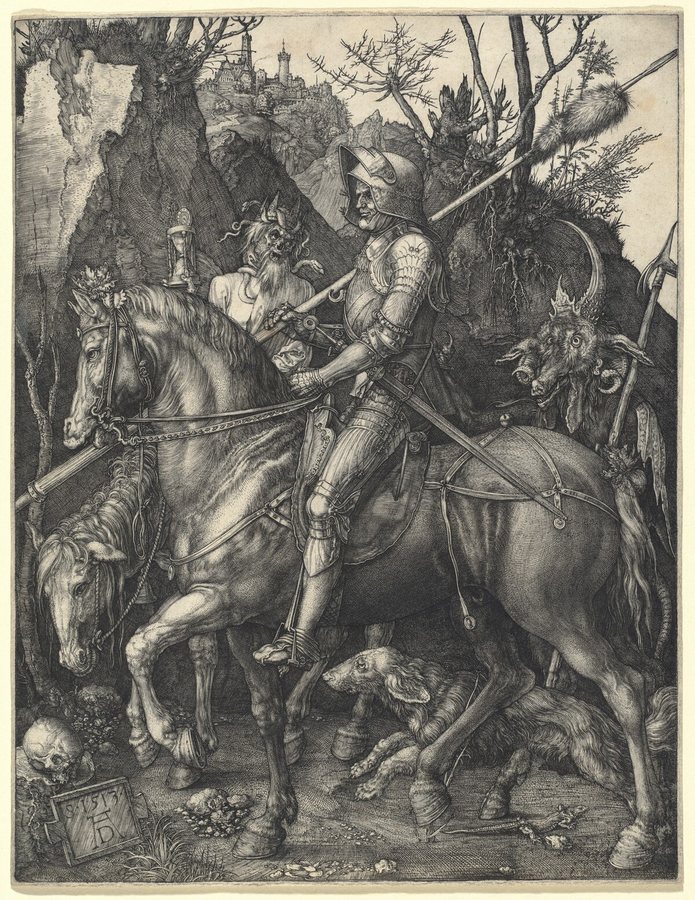
The knight rides through a gorge past Death, who holds up an hourglass, and a horned devil with a snout. A skull sits on a stump at lower left beside the tablet dated 1513, and a lizard runs under the horse. The rocks behind the riders are crosshatched so densely that they turn solid at small sizes, so use it full page and do not shrink it. National Gallery of Art, CC0.
Knight, Death and Devil. 1513. Albrecht Dürer. National Gallery of Art, Rosenwald Collection. CC0. Via Arkivism: https://arkivism.com/work/nga-6637
 Look closer ↗
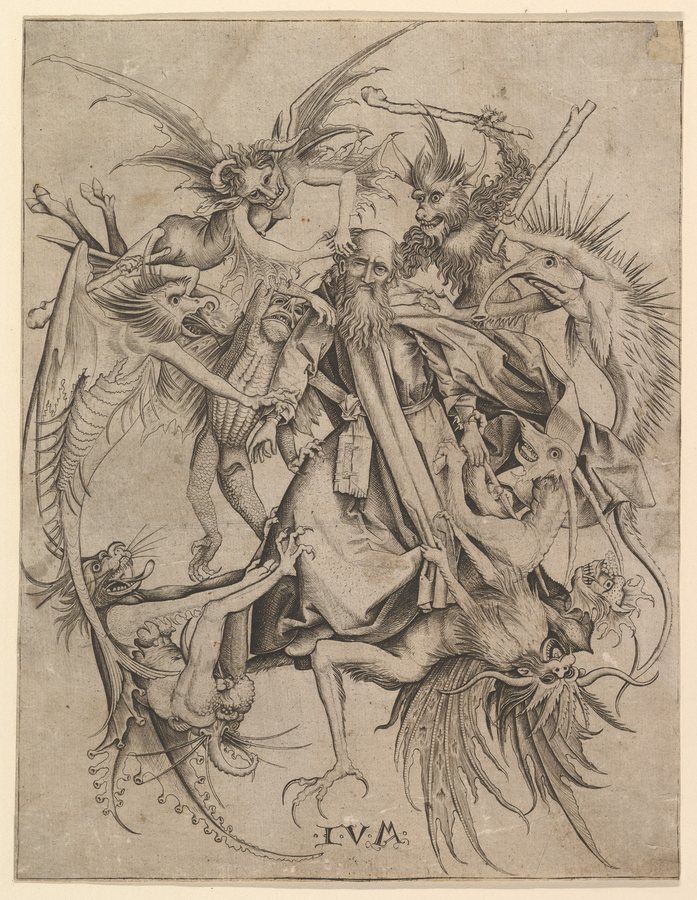
Demons with bat wings, fish scales and hedgehog spines pull at Anthony's hair, beard and robe as he floats among them. The engraver signed with the initials FVB at the bottom; the Met records him as Netherlandish, active about 1475 to 1500. The sheet has a grey tone, so set levels until the paper goes white or the whole image copies grey. Each demon crops out as its own monster portrait. Metropolitan Museum of Art, CC0.
Saint Anthony Tormented by Demons. late 15th century. Master FVB. The Metropolitan Museum of Art, Purchase, Joseph Pulitzer Bequest, 1917. CC0. Via Arkivism: https://arkivism.com/work/met-367078
 Look closer ↗
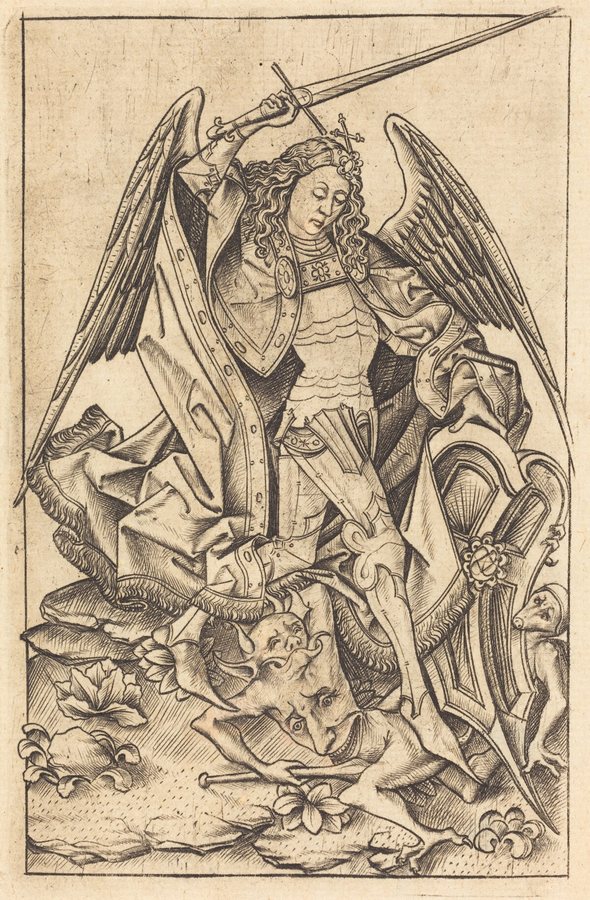
Michael stands on a demon with a second face on its belly, sword raised, while a small devil peers from behind his shield. The line is thin and even, which is elegant at full size and fragile when reduced. Print it at half a page or more, as a paladin portrait or a temple relief described in a room key. National Gallery of Art, CC0.
Saint Michael. c. 1470/1480. Israhel van Meckenem. National Gallery of Art, Rosenwald Collection. CC0. Via Arkivism: https://arkivism.com/work/nga-3354
 Look closer ↗
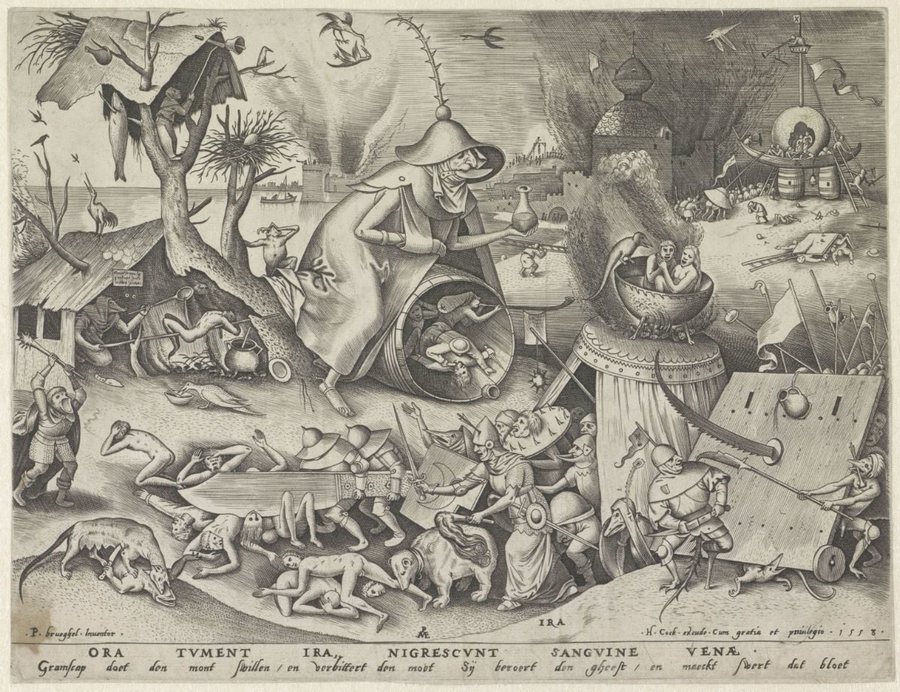
An armoured woman leads a war band of soldiers and monsters, a bear at her feet, while figures at right carry a giant knife like a battering ram. It belongs to the Seven Deadly Sins set published by Hieronymus Cock in 1558; Bruegel's and Cock's names are engraved in the margin. Crowded with small figures, it works as a spread or as a quarry for cropped vignettes. Rijksmuseum, public domain.
Toorn. 1558. Pieter van der Heyden. Rijksmuseum, Amsterdam. Public domain. Via Arkivism: https://arkivism.com/work/rijks-RP-P-1887-A-12304
 Look closer ↗
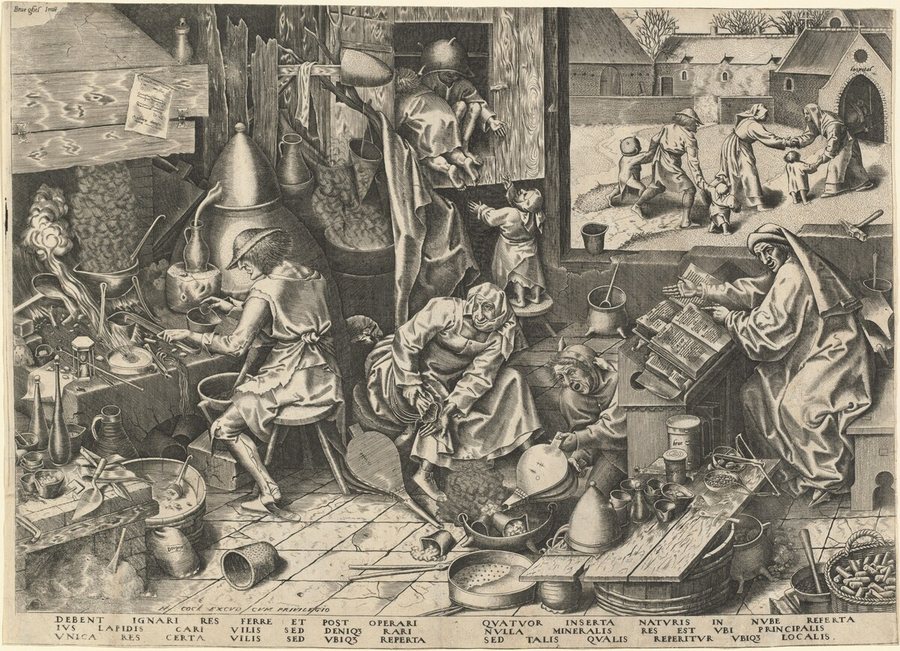
The alchemist works at his furnace, a woman sits in the clutter behind him, children climb in a cupboard and a scholar at right points to a book. Through the window at top right, a woman leads children toward a large building. The room is a full laboratory set, with stills, crucibles, bellows and a floor of tools. Crop the right third for a sage's study. National Gallery of Art, CC0.
The Alchemist. c. 1558. Philip Galle after Pieter Bruegel the Elder. National Gallery of Art, Print Purchase Fund (Rosenwald Collection). CC0. Via Arkivism: https://arkivism.com/work/nga-52140
 Look closer ↗
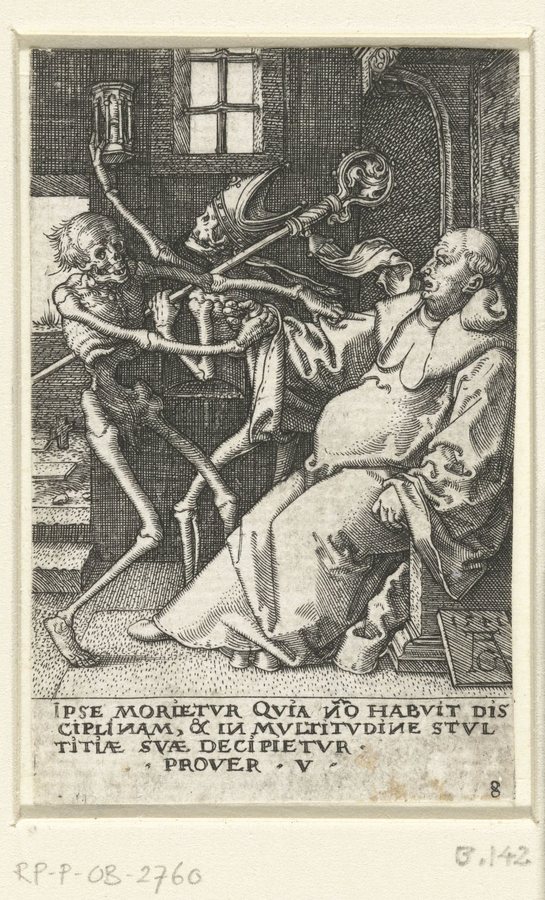
A skeleton hauls an abbot from his chair while a second skeleton, wearing a mitre, lifts an hourglass and a crozier; graves show through the doorway. It is the eighth of eight small prints on sin and death, with a Latin line from Proverbs below. The floor is stippled rather than hatched, so it copies cleanly at half a page. Rijksmuseum, public domain.
De Dood en de abt. 1541. Heinrich Aldegrever. Rijksmuseum, Amsterdam. Public domain. Via Arkivism: https://arkivism.com/work/rijks-RP-P-OB-2760
 Look closer ↗
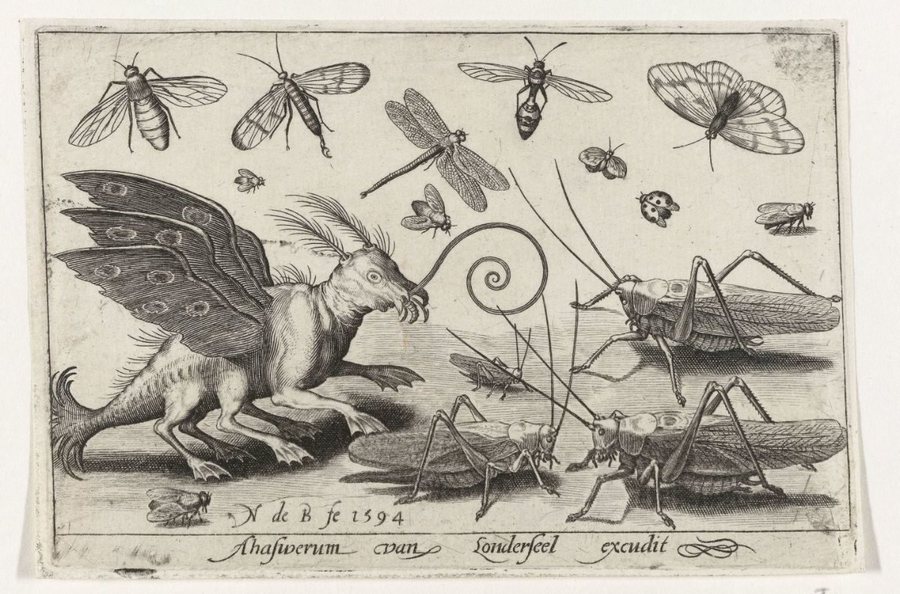
A hybrid with peacock-eye wings, a coiled proboscis and bird's feet stands among grasshoppers, flies, a dragonfly and a ladybird. De Bruyn signed and dated it 1594. The insects are drawn with the same care as the monster, which is what makes the monster believable. Clip the creature for a bestiary entry and the insects for page ornaments. Rijksmuseum, public domain.
Sprinkhanen en fantasiewezen met vleugels en zwemvliezen. 1594. Nicolaes de Bruyn. Rijksmuseum, Amsterdam. Public domain. Via Arkivism: https://arkivism.com/work/rijks-RP-P-1898-A-20009
Etchings: rooms, maps and frames
An etcher draws with a needle through a wax ground on a metal plate, and acid bites the exposed lines. The line is freer than an engraver's, and the longer the acid works, the deeper and blacker the line. Jacques Callot bit his plates in stages to push backgrounds back. This matters in two ways for a zine. Deep bites go solid black, which suits a dungeon. Light bites can fade on a cheap copier, so test before a full run.
 Look closer ↗
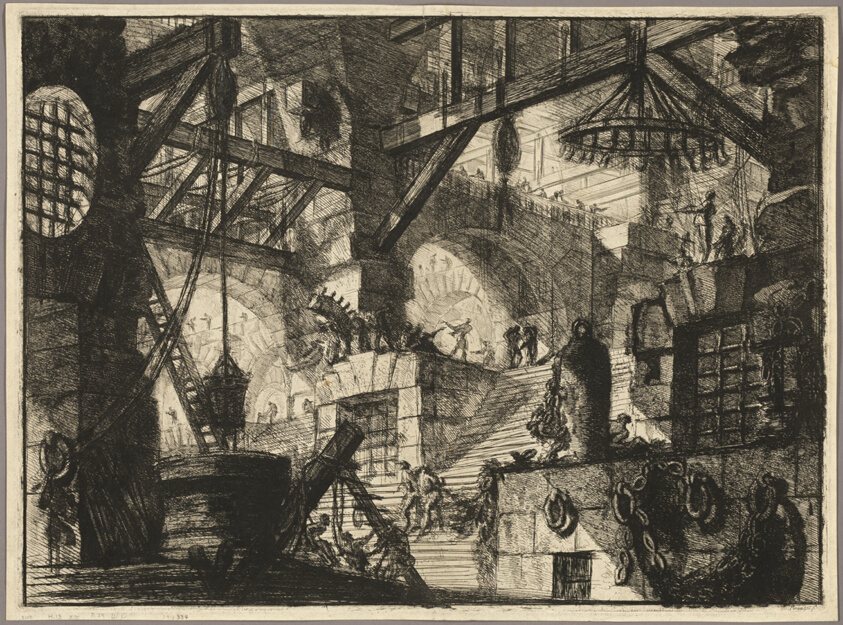
Piranesi's Imaginary Prisons are sixteen etchings of vaults, stairs and machinery. The first edition appeared around 1750, and he reworked every plate, darker, for the 1761 edition this impression comes from. The Well gives you a barred round window, a hanging iron hoop, chains and rings on the wall and prisoners crossing stairs at tiny scale. The image is 40 by 54.4 cm: a full-page establishing shot for a prison level. Art Institute of Chicago, CC0.
The Well, plate 13 from Imaginary Prisons. 1761. Giovanni Battista Piranesi, Italian, 1720-1778. The Art Institute of Chicago, Joseph Brooks Fair Memorial Collection. CC0. Via Arkivism: https://arkivism.com/work/aic-74630
 Look closer ↗
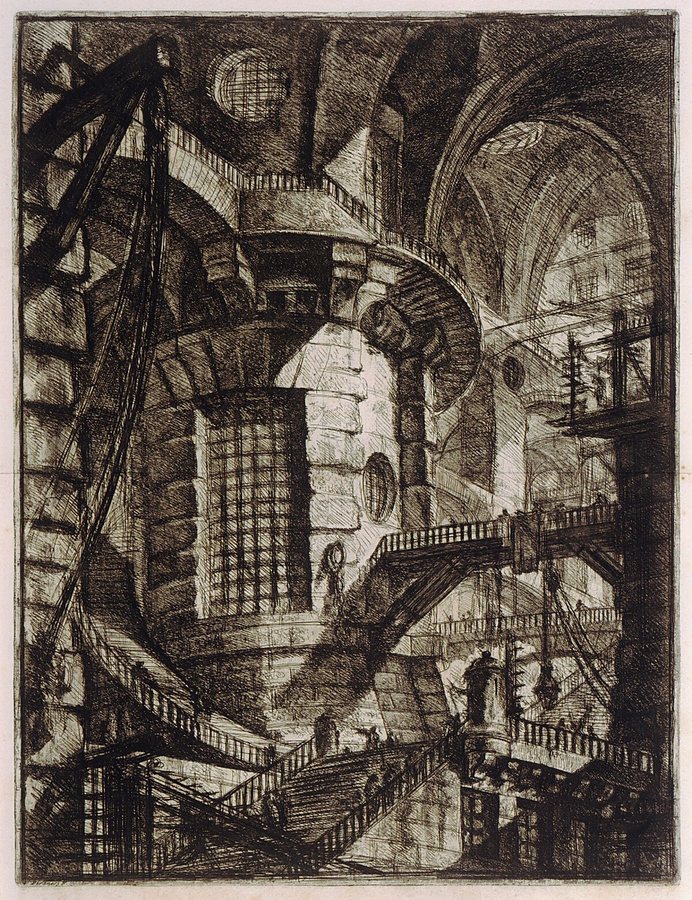
A drum-shaped tower with a barred grille is wrapped in stairs and bridges. The National Gallery's record lists sulphur tint or open bite beside the etched lines, which are ways of letting acid lay a grey tone over open areas. That tone turns to speckle on a copier. Push the contrast first, or keep the grit as dungeon texture. National Gallery of Art, CC0.
The Round Tower. published 1761. Giovanni Battista Piranesi. National Gallery of Art, Mark J. Millard Architectural Collection, acquired with assistance from The Morris and Gwendolyn Cafritz Foundation. CC0. Via Arkivism: https://arkivism.com/work/nga-62913
 Look closer ↗
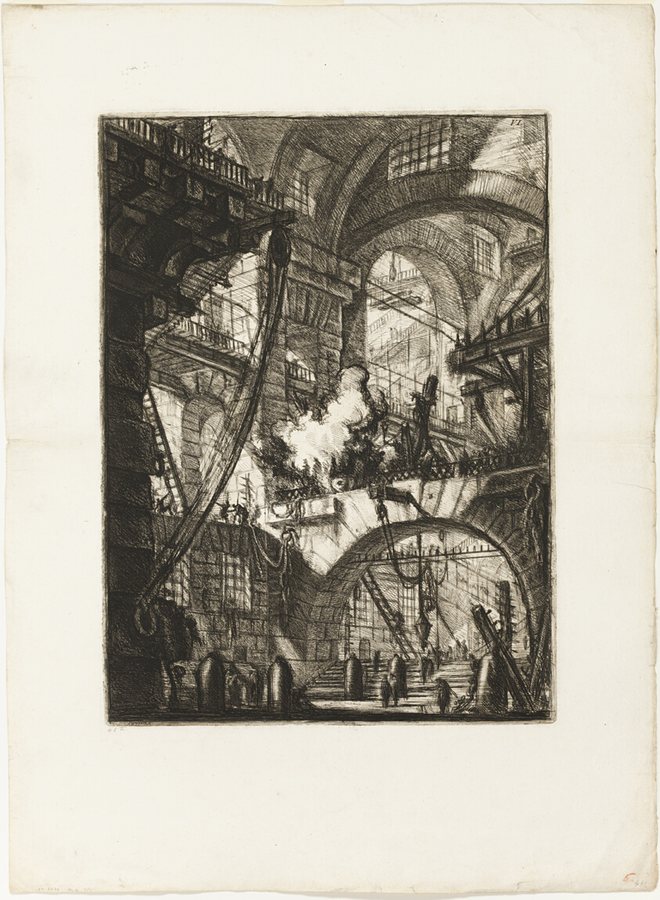
Smoke rises from a platform in the middle distance under a vast arch hung with ropes and a pulley. The scan shows the whole sheet with its wide margin, so crop to the plate mark. The image is portrait, 53.7 by 39.4 cm, and fits a zine cover without losing the vault. Art Institute of Chicago, CC0.
The Smoking Fire, plate 6 from Imaginary Prisons. 1761. Giovanni Battista Piranesi, Italian, 1720-1778. The Art Institute of Chicago, The Wallace L. DeWolf and Joseph Brooks Fair Collections. CC0. Via Arkivism: https://arkivism.com/work/aic-7356
 Look closer ↗
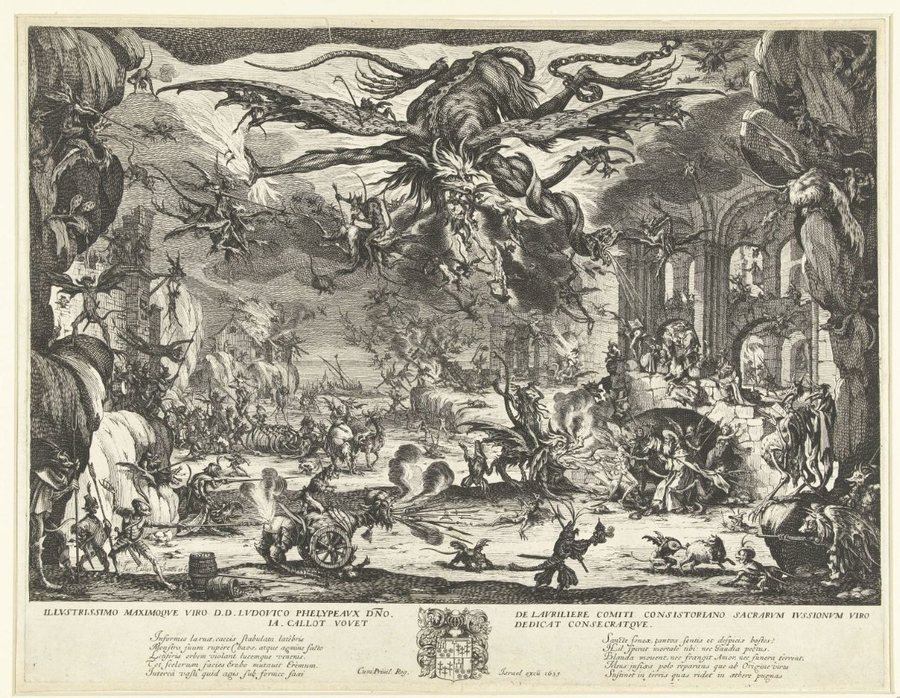
A chained, winged monster breathes smoke over a valley where devils fight, torture, set fires and fire a cannon, while Anthony is harried at a ruin on the right. Callot packed the plate with tiny figures. A whole wandering-monster table lives in here: crop single devils from the full-resolution file for monster portraits. Rijksmuseum, public domain.
De verzoeking van de Heilige Antonius. 1635. Jacques Callot. Rijksmuseum, Amsterdam. Public domain. Via Arkivism: https://arkivism.com/work/rijks-RP-P-OB-6578
 Look closer ↗
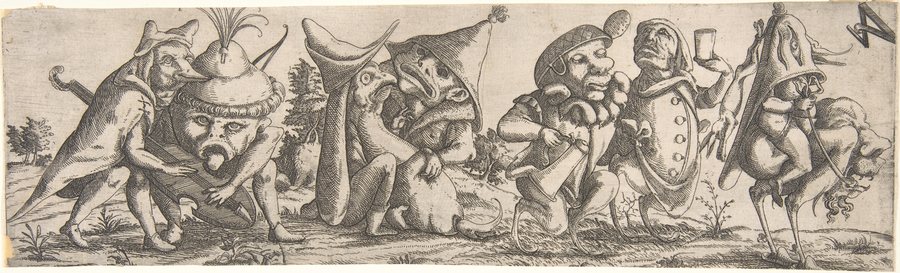
A strip of grotesques with oversized heads, a root-vegetable hat, a funnel hat and a raised drinking glass. It is the first of eight etched friezes, and the sheet is 9.4 by 31.8 cm. The long, low format is already a page header or footer. Metropolitan Museum of Art, CC0.
Procession of Monstrous Figures. 1615. Wendel Dietterlin, the Younger. The Metropolitan Museum of Art, A. Hyatt Mayor Purchase Fund, Marjorie Phelps Starr Bequest, 2002. CC0. Via Arkivism: https://arkivism.com/work/met-393859
 Look closer ↗
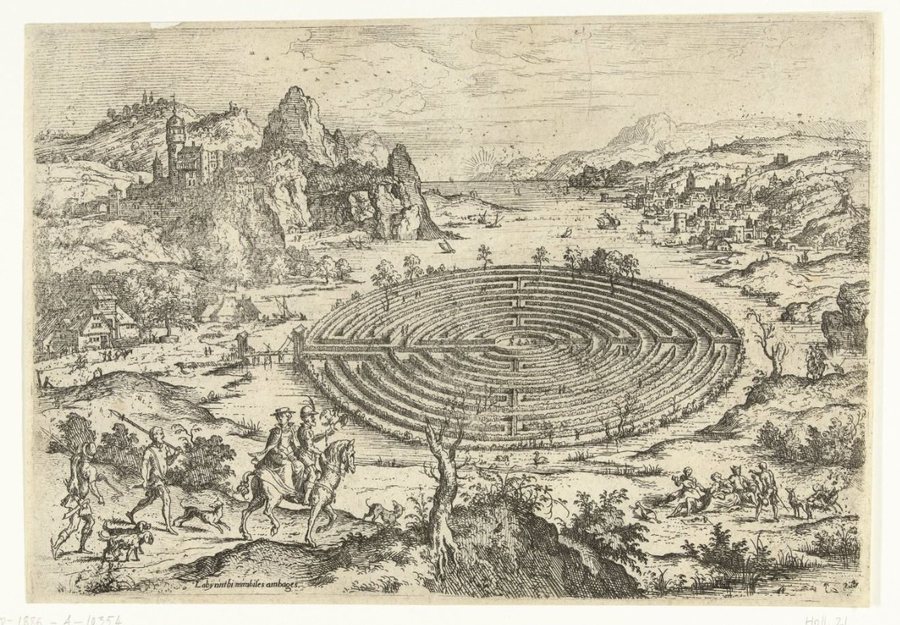
Hunters on a hill look down on the Cretan labyrinth, a round maze set in a bay and reached from land by a drawbridge, with a city and a castle beyond. The maze is drawn from above at a steep angle, close to a dungeon map, and the hunters in the foreground stand where a party would. Rijksmuseum, public domain.
Het Kretenzische labyrint. c. 1551 - before 1558. Hieronymus Cock. Rijksmuseum, Amsterdam. Public domain. Via Arkivism: https://arkivism.com/work/rijks-RP-P-1886-A-10354
 Look closer ↗
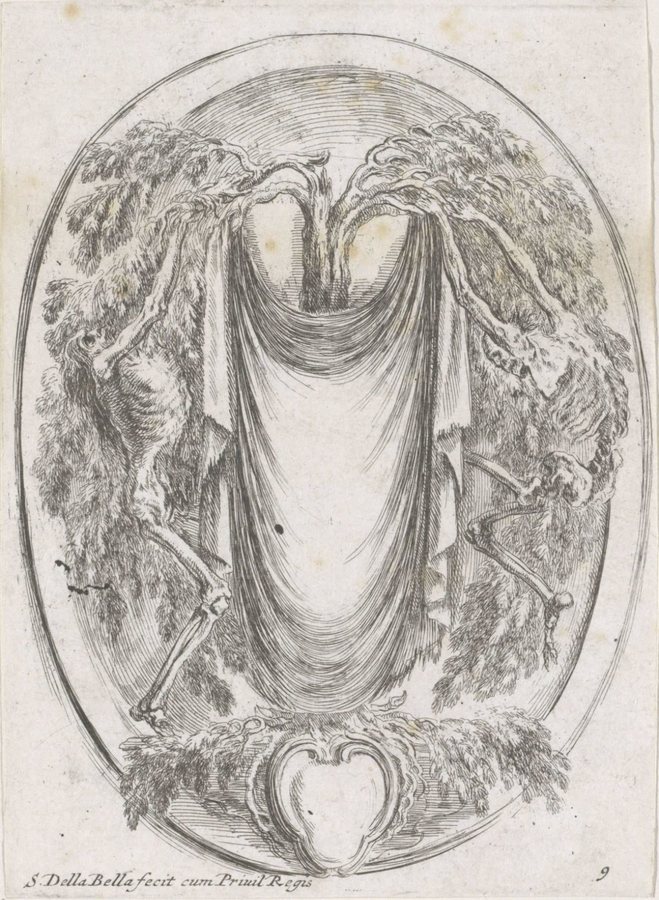
A blank shroud hangs from the branches of two trees, two skeletons hang beside it, and an empty cartouche waits below. The plate is numbered 9. The shroud is a title panel ready for type: a chapter opener, a cover or a character sheet header. Rijksmuseum, public domain.
Cartouche met lijkwade aan boomtakken en twee skeletten. 1647. Stefano della Bella. Rijksmuseum, Amsterdam. Public domain. Via Arkivism: https://arkivism.com/work/rijks-RP-P-OB-35.198
 Look closer ↗
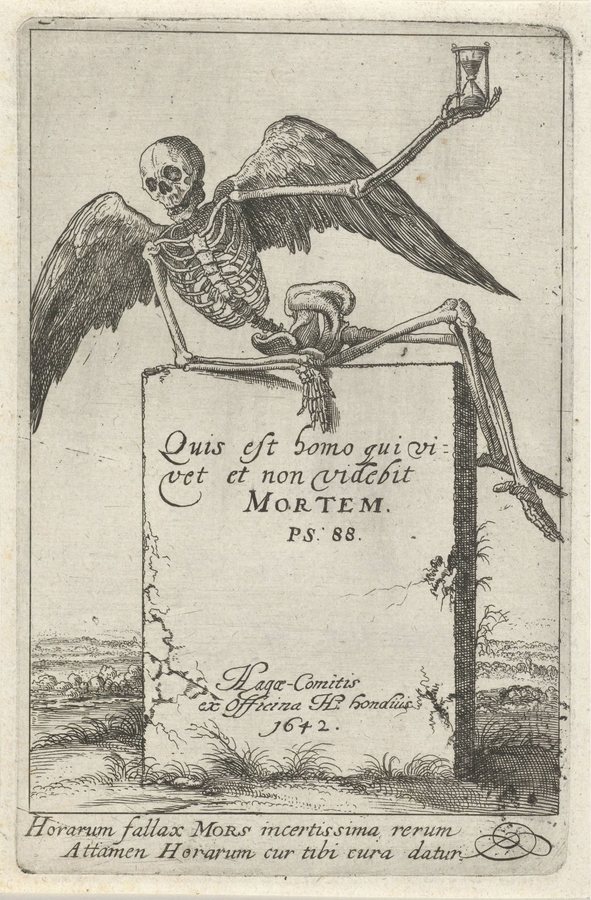
A winged skeleton lounges on a tombstone and holds up an hourglass. The stone carries a Latin question from Psalm 88, what man lives and shall not see death, and the line of Hondius's shop in The Hague. The Rijksmuseum places it in a series of skeleton prints. Clear the lettering and the stone becomes a title block or a frame for a random table. Rijksmuseum, public domain.
Gevleugeld skelet met zandloper op een grafsteen. 1642. Hendrick Hondius. Rijksmuseum, Amsterdam. Public domain. Via Arkivism: https://arkivism.com/work/rijks-RP-P-1996-324
 Look closer ↗
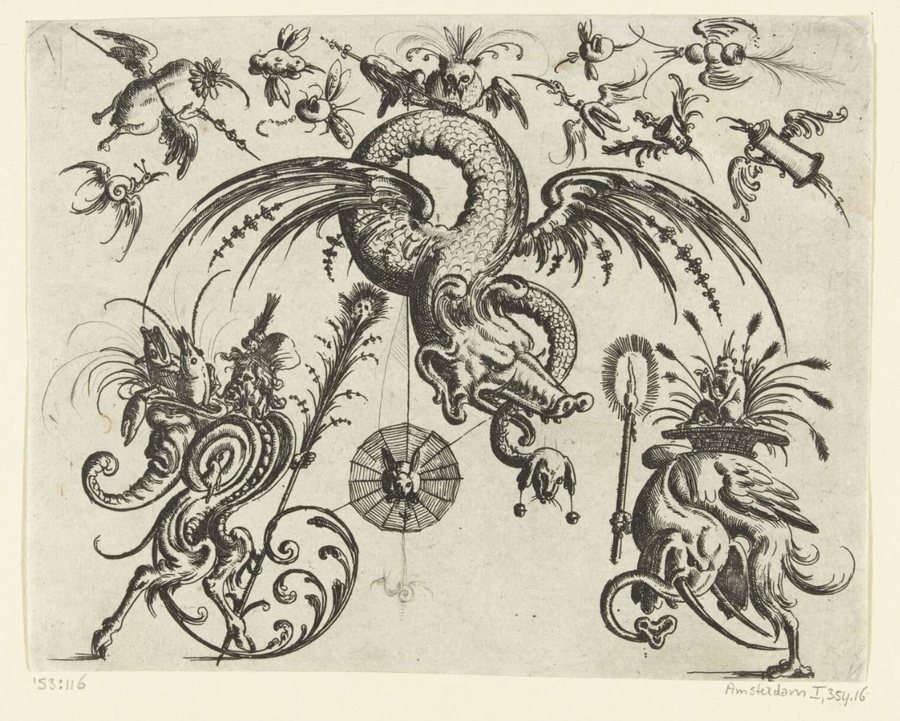
A winged dragon loops through the centre above a spider's web, between two grotesque beasts, with small flying oddities along the top. It is a leaf from Jamnitzer's series of flat decorations with grotesques, cartouches and fantastic creatures. The parts sit apart on the plate, so the dragon, the web and each beast crop cleanly into separate spot illustrations. Rijksmuseum, public domain.
Gevleugelde draak. 1573 - 1610. Christoph Jamnitzer. Rijksmuseum, Amsterdam. Public domain. Via Arkivism: https://arkivism.com/work/rijks-RP-P-1953-116
 Look closer ↗
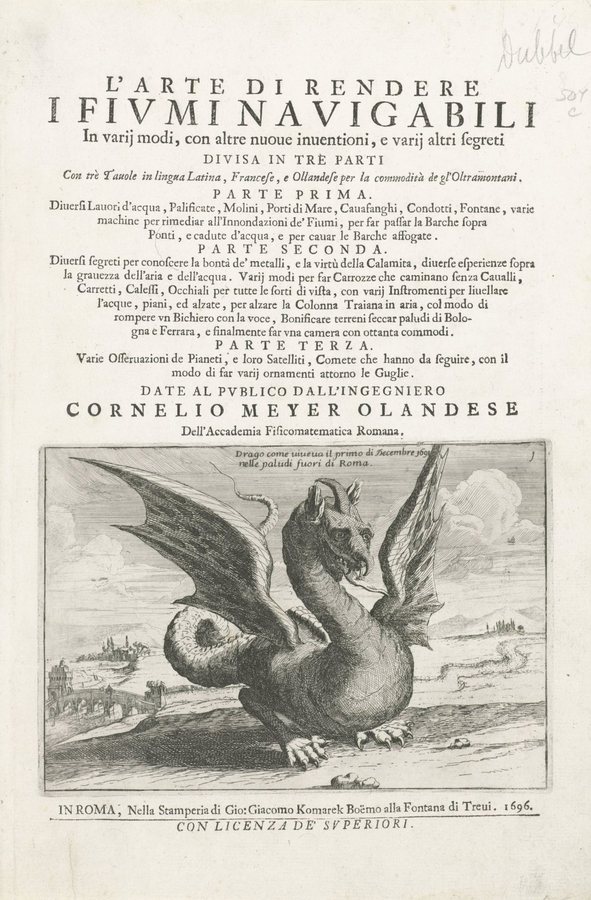
This is the title page of a book on making rivers navigable, printed in Rome in 1696 for the Dutch engineer Cornelis Meijer. The inscription over the etched dragon says it lived in the marshes outside Rome on 1 December 1691. A technical manual with a monster on its title page is a ready model for a zine's own: type block above, creature below. Rijksmuseum, public domain.
Draak in de moerassen buiten Rome. 1696. Cornelis Meijer. Rijksmuseum, Amsterdam. Public domain. Via Arkivism: https://arkivism.com/work/rijks-RP-P-OB-102.796
 Look closer ↗
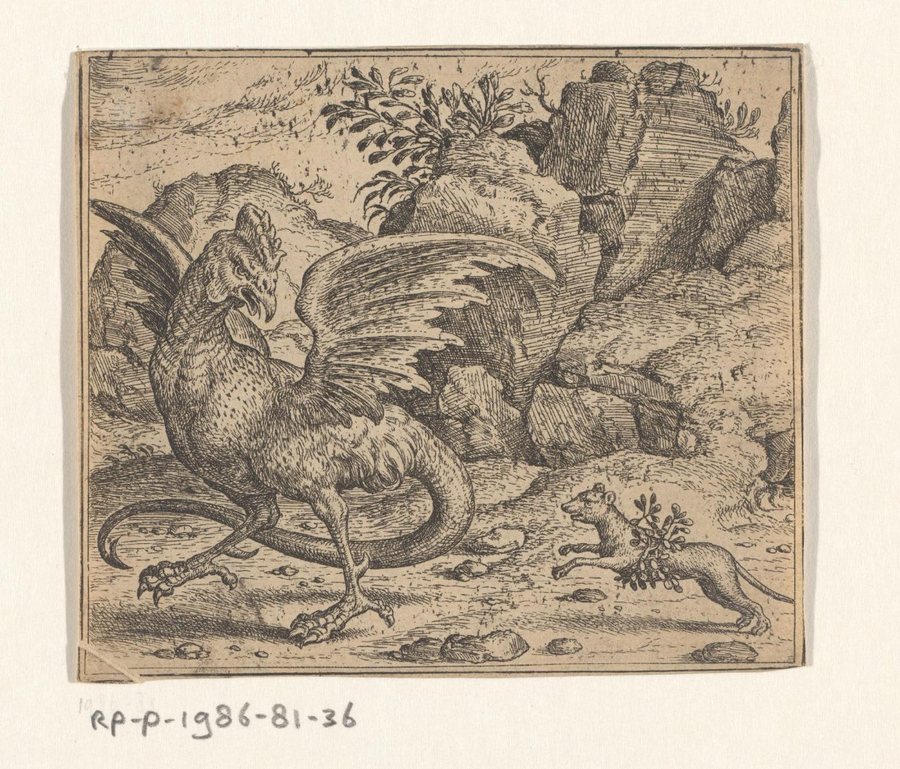
A basilisk, rooster's head and wings on a lizard's tail, faces a weasel that runs at it with a sprig of leaves on its back. The line is bold and open for an etching, close to a woodcut, so it copies well at a quarter page. Rijksmuseum, public domain.
Fabel van de basilisk en de wezel. 1567 - 1617. Marcus Gheeraerts (I). Rijksmuseum, Amsterdam. Public domain. Via Arkivism: https://arkivism.com/work/rijks-RP-P-1986-81-36
Rights and credit
All twenty-nine works are CC0 or marked public domain by the institutions that hold them: the Rijksmuseum, the National Gallery of Art, the Metropolitan Museum of Art, the Cleveland Museum of Art and the Art Institute of Chicago. That covers commercial zines. Each Arkivism work page carries the holding museum's credit line to paste into your colophon, and a link to the museum's own record.
Sources and picture credits
- Collection records (dates, techniques, dimensions, descriptions, rights):
- Imago Mortis, Rijksmuseum RP-P-2016-49-96-2: https://www.rijksmuseum.nl/en/collection/RP-P-2016-49-96-2 ; same page, attributed to Michael Wolgemut and workshop, Art Institute of Chicago: https://www.artic.edu/artworks/51535
- Holbein, The Nobleman (sheet 6.8 x 4.6 cm): https://clevelandart.org/art/1929.152
- Holbein, The Old Woman: https://clevelandart.org/art/1929.160
- Skeletons Making Music: https://www.nga.gov/collection/art-object-page.7769.html
- Letter O: https://www.nga.gov/collection/art-object-page.11939.html
- Dürer, Saint Michael Fighting the Dragon (image 39.2 x 28.3 cm): https://www.metmuseum.org/art/collection/search/368339
- Dürer, The Rhinoceros: https://www.nga.gov/collection/art-object-page.47903.html
- Cranach, Temptation of Saint Anthony (arms of Saxony, cave): https://www.rijksmuseum.nl/en/collection/RP-P-OB-4471
- Two Alchemists in Their Workshop: https://www.rijksmuseum.nl/en/collection/RP-P-2018-3210-15-1
- Posada, boy and demon (zincograph, image 8.7 x 16.2 cm): https://www.metmuseum.org/art/collection/search/735920
- Posada, broadsheet (type-metal engraving and letterpress on orange paper): https://www.metmuseum.org/art/collection/search/717520
- Dürer, Knight, Death and Devil: https://www.nga.gov/collection/art-object-page.6637.html
- Master FVB, Saint Anthony (Netherlandish, active ca. 1475 to 1500): https://www.metmuseum.org/art/collection/search/367078
- Van Meckenem, Saint Michael: https://www.nga.gov/collection/art-object-page.3354.html
- Van der Heyden, Wrath (armoured Wrath, bear, soldiers and monsters): https://www.rijksmuseum.nl/en/collection/RP-P-1887-A-12304
- Galle after Bruegel, The Alchemist: https://www.nga.gov/collection/art-object-page.52140.html
- Aldegrever, Death and the Abbot (eighth of eight on sin and death): https://www.rijksmuseum.nl/en/collection/RP-P-OB-2760
- De Bruyn, grasshoppers and fantasy creatures: https://www.rijksmuseum.nl/en/collection/RP-P-1898-A-20009
- Piranesi, The Well (image 40 x 54.4 cm): https://www.artic.edu/artworks/74630
- Piranesi, The Round Tower (sulphur tint or open bite): https://www.nga.gov/collection/art-object-page.62913.html
- Piranesi, The Smoking Fire (image 53.7 x 39.4 cm): https://www.artic.edu/artworks/7356
- Callot, The Temptation of Saint Anthony: https://www.rijksmuseum.nl/en/collection/RP-P-OB-6578
- Dietterlin, Procession of Monstrous Figures (frieze 1 of 8, sheet 9.4 x 31.8 cm): https://www.metmuseum.org/art/collection/search/393859
- Cock, The Cretan Labyrinth: https://www.rijksmuseum.nl/en/collection/RP-P-1886-A-10354
- Della Bella, cartouche with shroud and skeletons: https://www.rijksmuseum.nl/en/collection/RP-P-OB-35.198
- Hondius, winged skeleton (series of skeleton prints): https://www.rijksmuseum.nl/en/collection/RP-P-1996-324
- Jamnitzer, winged dragon (series of flat decorations with grotesques): https://www.rijksmuseum.nl/en/collection/RP-P-1953-116
- Meijer, dragon title page (inscription dated 1 December 1691, title page, attributed): https://www.rijksmuseum.nl/en/collection/RP-P-OB-102.796
- Gheeraerts, basilisk and weasel: https://www.rijksmuseum.nl/en/collection/RP-P-1986-81-36
- Background:
- Woodcut as a relief technique printed with movable type; Callot's staged biting of etching plates: https://en.wikipedia.org/wiki/Old_master_print
- Engraving with a burin on an intaglio plate: https://en.wikipedia.org/wiki/Engraving
- Etching through an acid-resistant ground: https://en.wikipedia.org/wiki/Etching
- Nuremberg Chronicle, printed by Anton Koberger, woodcuts from the Wolgemut workshop: https://en.wikipedia.org/wiki/Nuremberg_Chronicle
- Lützelburger cut the Dance of Death blocks after Holbein; book edition 1538: https://en.wikipedia.org/wiki/Hans_L%C3%BCtzelburger
- Dürer's Apocalypse, fifteen woodcuts, 1498, reissued 1511: https://en.wikipedia.org/wiki/Apocalypse_(D%C3%BCrer)
- Dürer's Rhinoceros, made from a description and sketch of the Lisbon animal of 1515: https://en.wikipedia.org/wiki/D%C3%BCrer%27s_Rhinoceros
- Piranesi's Imaginary Prisons, first edition c. 1750, reworked 1761: https://en.wikipedia.org/wiki/Carceri_d%27invenzione
- Posada's relief printing and popular broadsides: https://en.wikipedia.org/wiki/Jos%C3%A9_Guadalupe_Posada
- Dancing Skeletons (Imago Mortis). 1493. Rijksmuseum, Amsterdam. Public domain.
- Dance of Death: The Nobleman, c. 1526. Hans Holbein the Younger. The Cleveland Museum of Art, Dudley P. Allen Fund, 1929.152. CC0.
- Dance of Death: The Old Woman, c. 1526. Hans Holbein the Younger. The Cleveland Museum of Art, Gift of The Print Club of Cleveland, 1929.160. CC0.
- Skeletons Making Music. c. 1526. Hans Lützelburger after Hans Holbein the Younger. National Gallery of Art, Rosenwald Collection. CC0.
- Letter O. c. 1523. Hans Lützelburger after Hans Holbein the Younger. National Gallery of Art, Rosenwald Collection. CC0.
- Saint Michael Fighting the Dragon, from "The Apocalypse". 1511. Albrecht Dürer. The Metropolitan Museum of Art, The George Khuner Collection, Gift of Mrs. George Khuner, 1975. CC0.
- The Rhinoceros. 1515. Albrecht Dürer. National Gallery of Art, Rosenwald Collection. CC0.
- Temptation of Saint Anthony with demons attacking. 1506. Lucas Cranach the Elder. Rijksmuseum, Amsterdam. Public domain.
- Two Alchemists in Their Workshop. 1514 to 1532. Anonymous. Rijksmuseum, Amsterdam. Public domain.
- A young boy cowering from a demon. c. 1880 to 1910 (a later impression). José Guadalupe Posada. The Metropolitan Museum of Art, Gift of Roberto Berdecio, 1960. CC0.
- Broadsheet relating to skeletons rising from their graves. 1904. José Guadalupe Posada. The Metropolitan Museum of Art, The Elisha Whittelsey Collection, The Elisha Whittelsey Fund, 1946. CC0.
- Knight, Death and Devil. 1513. Albrecht Dürer. National Gallery of Art, Rosenwald Collection. CC0.
- Saint Anthony Tormented by Demons. Late 15th century. Master FVB. The Metropolitan Museum of Art, Purchase, Joseph Pulitzer Bequest, 1917. CC0.
- Saint Michael. c. 1470/1480. Israhel van Meckenem. National Gallery of Art, Rosenwald Collection. CC0.
- Wrath. 1558. Pieter van der Heyden. Rijksmuseum, Amsterdam. Public domain.
- The Alchemist. c. 1558. Philip Galle after Pieter Bruegel the Elder. National Gallery of Art, Print Purchase Fund (Rosenwald Collection). CC0.
- Death and the Abbot. 1541. Heinrich Aldegrever. Rijksmuseum, Amsterdam. Public domain.
- Grasshoppers and fantasy creatures with wings and webbed feet. 1594. Nicolaes de Bruyn. Rijksmuseum, Amsterdam. Public domain.
- The Well, plate 13 from Imaginary Prisons. 1761. Giovanni Battista Piranesi. The Art Institute of Chicago, Joseph Brooks Fair Memorial Collection. CC0.
- The Round Tower. Published 1761. Giovanni Battista Piranesi. National Gallery of Art, Mark J. Millard Architectural Collection. CC0.
- The Smoking Fire, plate 6 from Imaginary Prisons. 1761. Giovanni Battista Piranesi. The Art Institute of Chicago, The Wallace L. DeWolf and Joseph Brooks Fair Collections. CC0.
- The Temptation of Saint Anthony. 1635. Jacques Callot. Rijksmuseum, Amsterdam. Public domain.
- Procession of Monstrous Figures. 1615. Wendel Dietterlin the Younger. The Metropolitan Museum of Art, A. Hyatt Mayor Purchase Fund, Marjorie Phelps Starr Bequest, 2002. CC0.
- The Cretan Labyrinth. c. 1551 to before 1558. Hieronymus Cock. Rijksmuseum, Amsterdam. Public domain.
- Cartouche with a shroud on tree branches and two skeletons. 1647. Stefano della Bella. Rijksmuseum, Amsterdam. Public domain.
- Winged skeleton with hourglass on a tombstone. 1642. Hendrick Hondius. Rijksmuseum, Amsterdam. Public domain.
- Winged dragon. 1573 to 1610. Christoph Jamnitzer. Rijksmuseum, Amsterdam. Public domain.
- Dragon in the Marshes Outside Rome. 1696. Attributed to Cornelis Meijer. Rijksmuseum, Amsterdam. Public domain.
- The Fable of the Basilisk and the Weasel. 1567 to 1617. Marcus Gheeraerts the Elder. Rijksmuseum, Amsterdam. Public domain.
Work captions keep their institutions and source links. Every image is public domain or CC0 as recorded by the holding institution.