Journal · A closer look
Isle of the Dead.
The boat never arrives.
Böcklin painted this island five times. Follow the boat, look into the cliffs, then switch between three versions to see how the light changes the story.
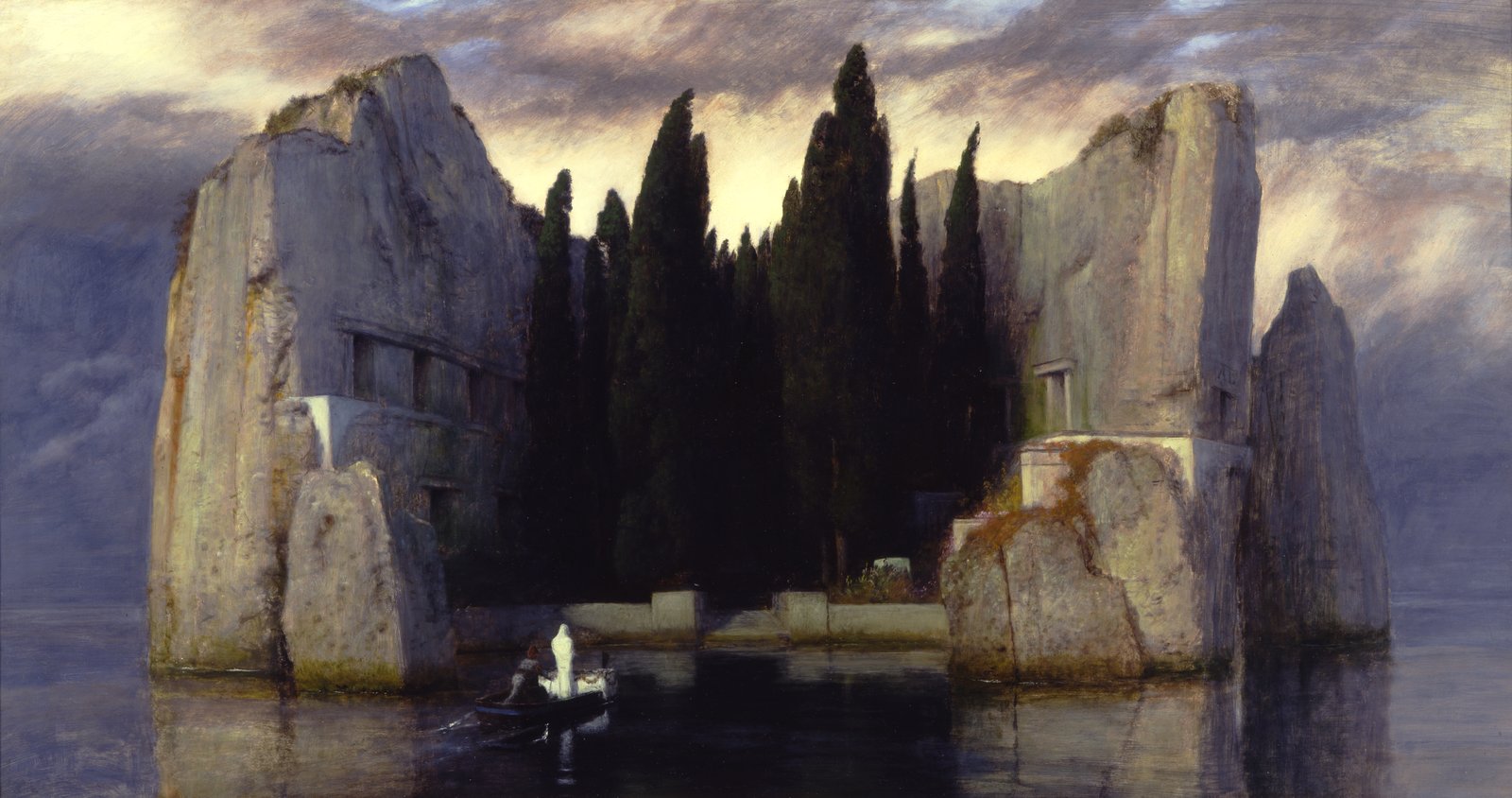
Arnold Böcklin, The Isle of the Dead, 1883. Staatliche Museen zu Berlin, Alte Nationalgalerie / Andres Kilger. Public Domain Mark 1.0 · Museum record.
Three details to look for
1. The passenger
A white figure faces away from us, standing behind a coffin. We arrive behind them, close enough to share the journey, too far away to know who they are.
2. The destination
The openings in the rock are burial chambers. The island has a place for the dead, but nobody comes out to meet the boat.
3. The darkness
Light catches the cliffs while the cypresses remain almost black. The steps lead towards that darkness, then disappear beneath it.
The coffin was a widow’s request.
In 1880, Marie Berna visited Böcklin’s Florence studio and saw an unfinished island painting. She commissioned a version in memory of her late husband. At her request, Böcklin added the covered coffin and the standing figure.
That version is now in New York. Knowing why it was made changes the journey: this imaginary place began as an image with which someone could remember a particular person.
Commission history: The Metropolitan Museum of Art.
Change the painting.
Watch the mood shift.
The boat stays on the water. The difference is in the place waiting for it.
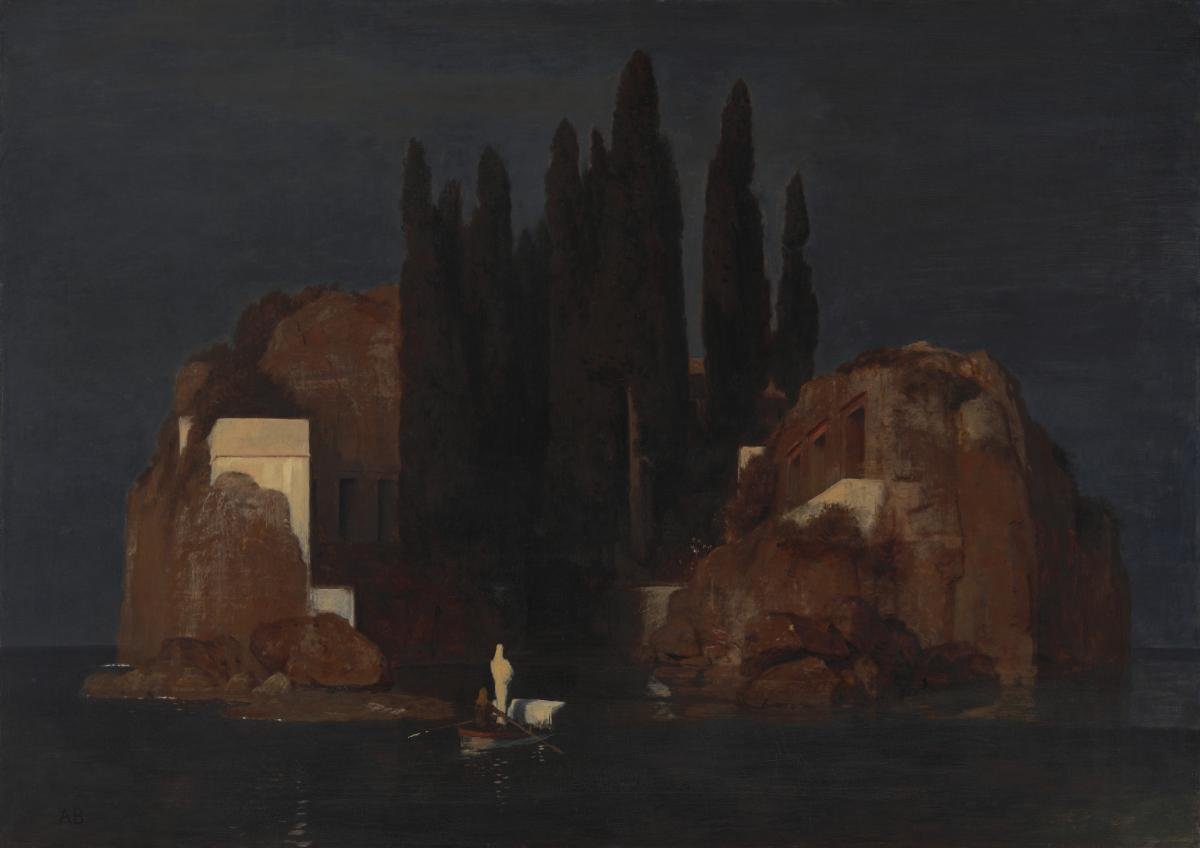
In Basel’s painting, the trees rise above the enclosing rock. Compare the island’s outline with the wider, paler cliffs in Berlin.
Arnold Böcklin. Kunstmuseum Basel, deposit of the Gottfried Keller Foundation. Public domain, as recorded by Arkivism. Museum source · Open in Arkivism ↗
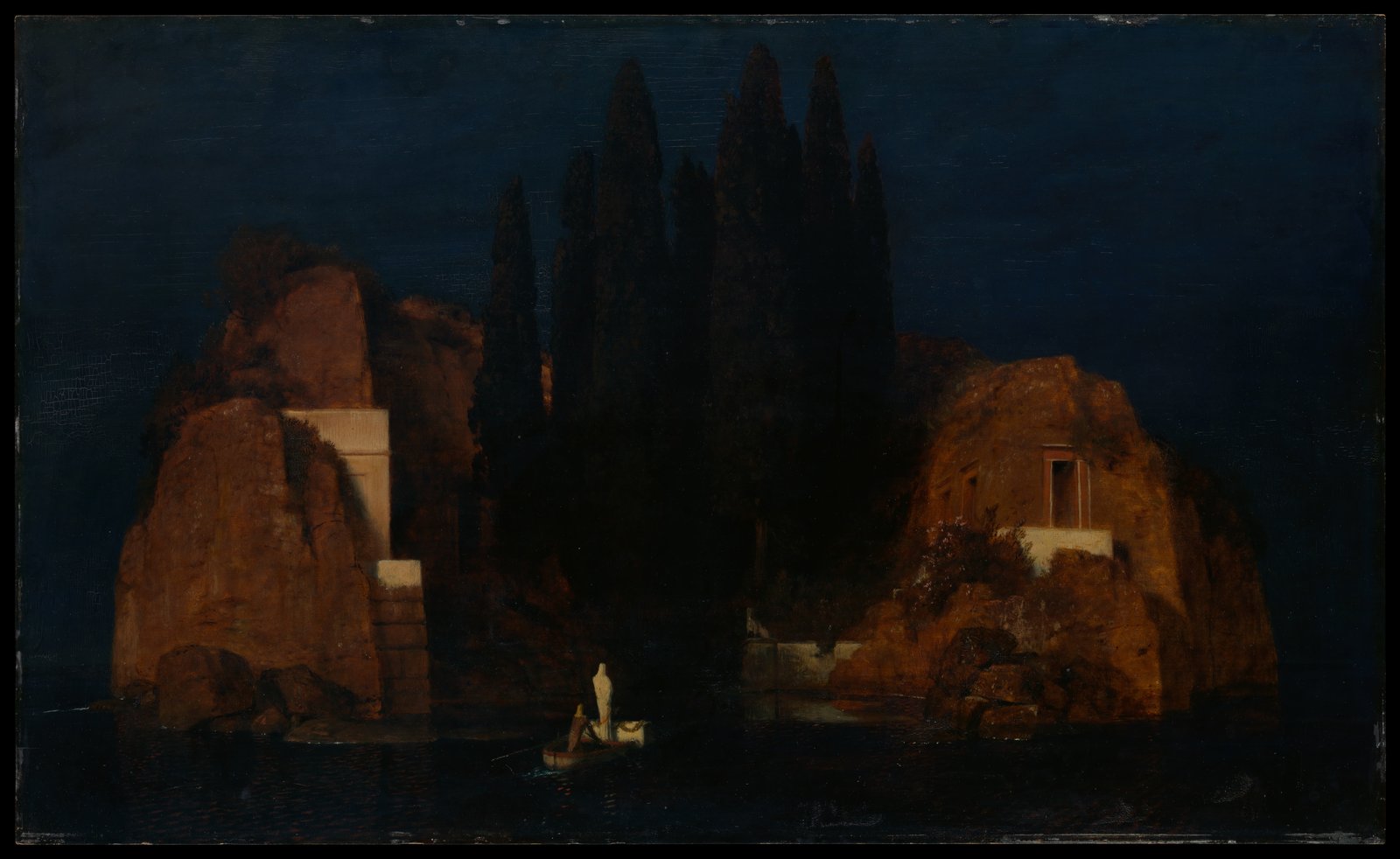
Warm brown rocks stand against blue darkness. The trees barely separate from the sky, and the boat sits low in the picture. This is Marie Berna’s commission.
Arnold Böcklin. The Metropolitan Museum of Art, Reisinger Fund, 1926. CC0. Museum source · Open in Arkivism ↗
The cliffs catch the light and the sky opens up. We can see more of the island, but the landing still leads into darkness.
Arnold Böcklin. Staatliche Museen zu Berlin, Alte Nationalgalerie / Andres Kilger. Public Domain Mark 1.0. Museum source · Open in Arkivism ↗
These observations describe the paintings’ visible differences. They do not establish a single intended meaning.
What does the island mean?
The coffin, burial chambers and cypresses carry the imagery of death and mourning. The Met’s curator Alison Hokanson reads the scene as a passage towards death that stops before telling us what lies beyond.
The picture did not remain private. Art dealer Fritz Gurlitt commissioned the Berlin version and an etching after it by Max Klinger. Reproductions carried the island into other people’s homes.
Look back at the boat. It has hardly any distance left to travel. Böcklin found a way to make that last stretch of water last indefinitely.
Interpretation: The Met’s audio commentary. Reproduction history: Alte Nationalgalerie.
Sources and picture credits
- Kunstmuseum Basel: five versions, dates and surviving collections
- The Met: Marie Berna’s commission and curatorial commentary
- Alte Nationalgalerie: the Berlin painting and its circulation
Work captions retain their institutions and source links. The comparisons of light and framing are Arkivism’s visual reading.